Phenomenological Anti-gravity Theory => predicts the following properties of the Ballon: :
1. The ballon effect manifests only if there is a horizontal component to the jump. In vertical jumps, the ballon effect does not manifest.
2. The Ballon effect is not hovering in the air, but a change in the flight trajectory. What Ter-Ovanesyan noticed.
It is important because :
The first gives us the opportunity to notice the effect when comparing the time of the long jump and time of the vertical jump.
The second one gives us the opportunity to see ballon. Let's compare the trajectories.
In accordance with the laws of ballistics, the trajectory of a common long jump should be symmetrical with respect to the highest point of the jump.
If you create a stroboscopic photograph of Byron Jones's long standing jump jump based on its video recording.
(https://www.youtube.com/watch?v=n0UeHxglMJ4)
We see nothing out of the ordinary here. The trajectory of his jump is almost symmetric about the highets point (L1 = L2). The trajectory goes up a little faster in the first half of the jump. This is due to a sharp upward swing of the hands. Hands pull up the body of the jumper.
And now, take a look at the trajectory of Bob Beamon's jump. :
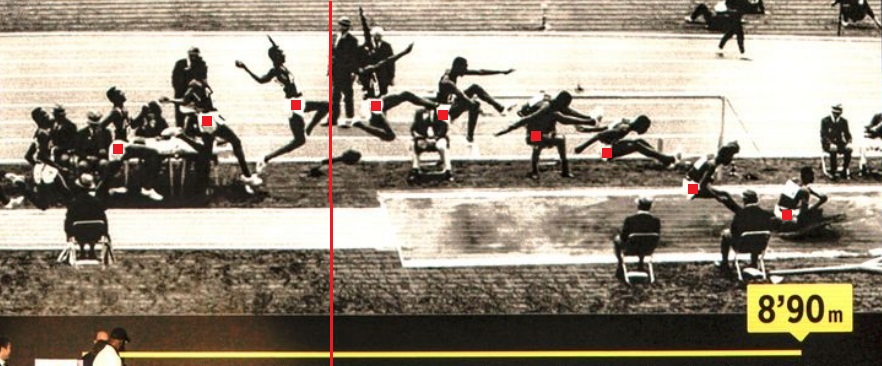
https://www.skysports.com/olympics/news/15234/12363353/bob-beamon-olympic-long-jumper-on-incredible-world-record-jump-in-1968-and-why-he-protested =>
An anomalous effect is clearly visible. :
1. The first half of the jump (up to the red line) is steeper, while the second half (after the red line) is more gradual.
2. The duration of the second half of the jump is longer than that of the first. This is precisely that "invisible parachute" Ter-Ovanesyan spoke of. :
" In Beamon’s mid-flight, or even more so in the second half, at the moment when other jumpers fall like stones, this miracle occurred—the ‘ballon,’ and he hung above the diving pit, as if on an invisible parachute.”. =>
3. The length of the second part of the jump is greater than that of the first.
The various trajectories of these jumps are shown in the figure below. :
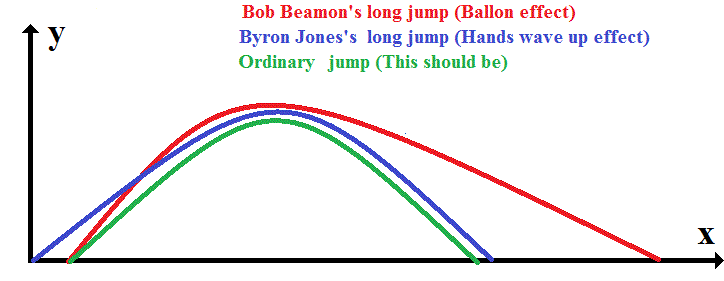
The differences in the trajectories of these jumps are explained on the page. =>