Anti-Gravity Experiments
www.HomoTechnologies.com (Main Page) =>
I n d e x :
1. Anti-Gravity Experiments.
Antigravity experiments are :
1. Change of the Gravitational Mass of Projection Powders.
2. Change in the gravitational mass of substances that were transfered properties of Projection Powders.
3. Gravitational shielding of of Projection Powders.
4. Gravitational shielding of substances that were transfered properties of Projection Powders.
Experiments with anti-gravity are important to us because anti-gravitational properties:
- They are easily measurable;
- They are most rapidly transferred to substitute substances.
Both of these qualities are essential for the development of systems for information-based applications—specifically:
- Obtainin information from the past and the future; =>
- Influencing the future. =>
2. Schemes of Anti-Gravity Experiments.
We used five schemes to detect anti-gravitational effects:
1. Anti-gravity rotating shield.
2. Measurement of gravitational mass (weight) on precision scales.
3. Rotation of samples on a hand drill.
4. Throwing of samples at an angle to observe asymmetries оf the trajectories.
5. Throwing out samples from the table.
2.1. Anti-gravity rotating shield.
This is a scheme for detecting antigravitational shielding.
A balance scale was positioned above the antigravity shield or samples of substances with hypothesized antigravitational properties. Typically, the anti-gravity shield rotates rapidly (several thousand revolutions per minute), and experimenter observed a change in the balance scale.
We started conducting these experiments. However, we quickly realized that such experiments do not allow for the detection of a gravitational field shielding effect. The reasons are as follows:
1. Air currents.
2. Vibration.
3. Rapid decrease in the shielding effect with increasing distance from the screen; it is inversely proportional to the square of the distance from the antigravity shield.
Since the expected change in weight was negligible (no more than 1%), we were unable to detect such antigravity effects against the background of the adverse impacts listed above. Therefore, we took a different path. We began searching for a violation of the equality of gravitational and inertial mass.
2.2. Measurement of gravitational mass (weight) on precision scales.
We employ this method when a change in gravitational mass over time is anticipated. When the antigravitational properties of projection powders are transferred to ordinary substances. We use scales with a precision of 1 mg. For a sample weight of 10–50 grams, this yields an accuracy of better than 0.01%, which is sufficient for our experiments.
2.3. Rotation on a hand drill.
This method is based on the fact that the force holding the sample on a rotating disk (frictional force) depends on the gravitational mass, and the centrifugal force that throws the sample off the rotating disk depends on the inertial mass. Thus, if we have two samples of equal weight, we can determine which sample possesses the greater inertial mass.
2.4. Throwing at an angle to observe asymmetries оf the trajectories.
This method simulates Bob Beamon's jump (See =>). It is very poor. Bob Beamon jumped 9 meters; we threw our samples only 30 to 40 centimeters. Therefore, it is impossible to observe any asymmetry in the trajectory.
2.5. Throwing out samples from the table.
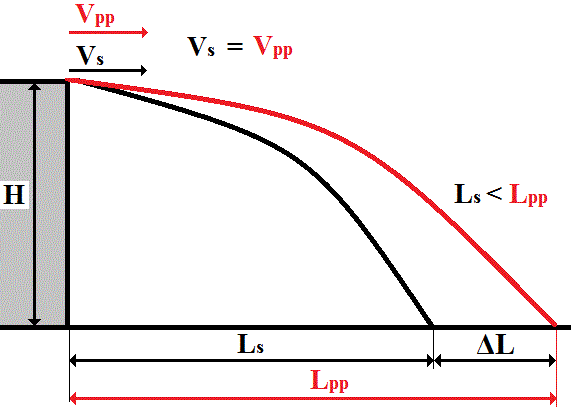
Experiment Description.
There are two samples:
pp - Projection powder or a sample treated with projection powders.
s - Ordinary salt or ordinary sample.
We drop them from the edge of a table at the same velocity.
We know the height of the table H. So, we can calculate the flight time (the time of fall) for ordinary sample. We know distance Ls and the flight time, so we can calculate the velocity Vs for the ordinary sample. Knowing the velocity Vpp = Vs and the distance Lpp, we can calculate the flight time for the sample treated with projection powders. Knowing the flight time for Samplepp and the height of the table H, we can calculate the reduction in gravitational mass for samplepp. Simplest calculation show
ΔMg/Mi ≈ 2*(ΔL/Ls)
Where Mg - Gravitational mass,
Mi - Inertial mass = previos gravitational mass.
ΔL - Change in Distance.
Ls -Distance for a standard sampleю.
Problems with this Experiment.
In this experiment, we had two problems:
1. Slippage.
When the samples fell to the floor, they would slide forward, sometimes by one or two inches. We resolved this issue by placing a board covered with fine sand on the floor; in this setup, if a sample slid, we could see its trail and the exact spot where it initially landed.
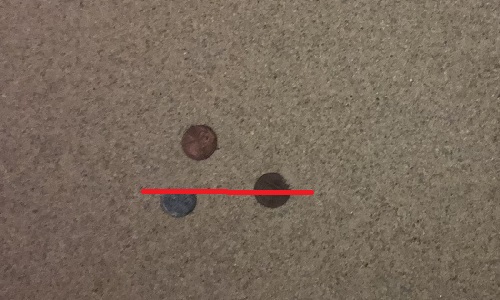
2.The Problem of Equal Velocities
We need to be sure that all samples fell from the table with the same horizontal velocity. We do this in the following way.
1. We are taking three samples.
2. We place the sample with antigravity property in the middle, between two standard samples.
3. We drop all three samples, but we consider only those trials in which samples 1 and 3 lay along a single straight line during the fall. (See picture on the left.)
We consider this scheme to be the best. Using this scheme, we can precisely calculate the antigravitation coefficients. We only need to accurately measure the distance and ensure that both samples are dropped from the edge of the table at the same speed. All calculations can be made by schoolchild.
3. Results of Anti-Gravity Experiments.
3.1. Change of the Gravitational Mass of Projection Powders.
3.2. Change in the gravitational mass of substances that were transfered properties of Projection Powders.
Conducting experiments according to scheme 2.5. we found that antigravity property can be transferred metallic. We use common coins (See picture above on the left). We conducted 100 experiments, and in 85 of them, we obtained a positive result. Average ΔL was 0.5 inch. Which corresponds to a 2% change in gravitational mass.
It is very important result. It demonstrates that it is possible to construct an aircraft utilizing an antigravitational shield without employing the red projection powder.
3.3. Gravitational shielding of Projection Powders.
We measured effect of antigravity shielding of the projection powder efect as follows, using experiment 2.5.
1. We measured the decrease in the gravitational mass of two packets containing projection powders.
2. We placed a sample of ordinary matter between these two packets containing red projection powder and measured the decrease in the gravitational mass of the "sandwich" (two packets with a sample between them).
3. The reduction in gravitational mass of the sandwich proved to be greater than the reduction of the two packets of red powder in the control run (without a sample).
4. We attribute this reduction in gravitational mass to the shielding effect of the gravitational field produced by packets of red projection powder.
3.4. Gravitational shielding of substances that were transfered properties of Projection Powders.
A repetition of the experiment (3.3.), not with projection powders, but with substances that had been transformed the properties of projection powders.
www.HomoTechnologies.com (Main Page) =>