1
Let a particle with an inertial mass min at time t = 0 begin free movement from the origin (x = 0, y = 0) with the initial velocity vx(0) = vx0, vy(0) = vy0. The gravitational field g is uniform and directed along the Y axis: g = g (y) = - ∂φ/∂y.
In the case of the usual physical interaction (obtaining open information), we have the equations for the trajectory of the particle :
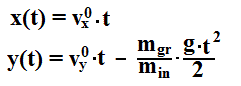 , (1a)
. (1b)
The trajectory of the particle is a parabola.

(2)
Pphys is the focal parameter. For the case of ordinary physical interaction, it is:
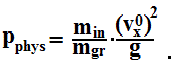
(3)
The flight time T0, the flight length L0 and the flight height H0 for such a movement are:
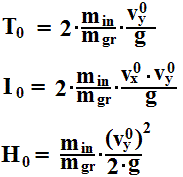
, (4a)
, (4b)
. (4c)
If crypto-information interactions are taken into account, then it is necessary to integrate equations :
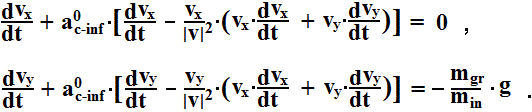
(5а)
(5b)
Equations (5) can be written as :
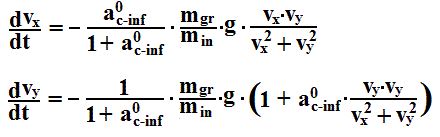
, (6a)
. (6b)
If a0c-inf << 1, then
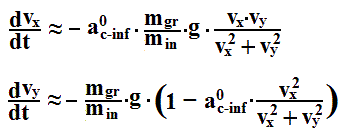
, (7a)
. (7b)
From equations (6) we see that the trajectory is asymmetric with respect to the highest point of rise.
At the second stage (when the particle goes down), the trajectory is more gentle than when rising.
To solve these equations, if vx0 ≠ 0, we will take into account the fact that a0c-inf << 1
(experiments show that a0c-inf ~ 0.1).
Then we will seek a solution to the system of equations (7) in the form of an expansion in
vx(t) = vx0 + (a0c-inf) · vx1 + (a0c-inf)↑2∙ vx2 + . . . ,
(8a)
vy(t) = vy0 + (a0c-inf) · vy1 + (a0c-inf)↑2∙ vy2 + . . . .
(8b)
For vx0 and vy0 we have equations for the case of open information (1), and accordingly the same curve (symmetric parabola (2) with parameters (3, 4)).
Equations for vx1 and vy1 are
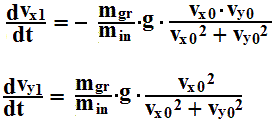
, (8a)
. (8b)
Where
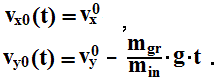 (9a)
(9a)
(9b)
From (7b) we can see that crypto-informational interaction always reduces external gravitational field.
Integrating obtain :
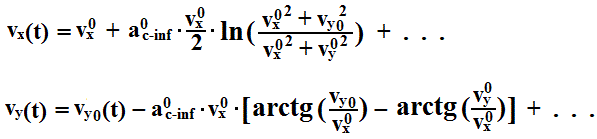 , (10a)
. (10b)
We choose constants in such a way that at t = 0, vx(0) = v0x и vy(0) = v0y.
Near maximum hight point vx0 >> vy0. In this case, near this point
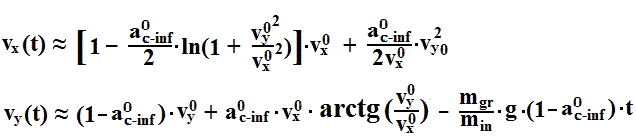
, (11a)
. (11b)
From (11) we see that the trajectory of motion is an asymmetric trajectory close to a parabola with a focal parameter:
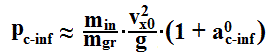
. (12)
Flight time T and flight range L are:
 , (13a)
. (13b)
Where T0 is (4a), and vx(t) is (11a). We do not need to integrate (13b) and obtain the exact value for the flight range, since we do not know the constant a0c-inf. But

. (14)
L0 is (4b). If v0x = v0y, then

(15)