Return to the HomoTechnologies.com =>
This is our flagship project, which gives us strength and inspiration in our work.
I n d e x
(Problems of Manned Interplanetary Expeditions).
=>

Humanity moves forward thanks to dreamers. But it is businessmen who bring these projects to life. And they dictate the terms to the dreamers. Therein lies the tragedy of dreamers. How to unite these two opposing entities ?
The ideal is when a businessman is just as much of a dreamer - like Elon Musk.
Our experiments demonstrate that the anti-gravity technologies will make space travel hundreds of times cheaper, simpler, and more reliable than existing space technologies. Nevertheless, the anti-gravity project needs money. NASA requires trillions of dollars for a mission to Mars. We need a hundred times less - but that still amounts to tens of billions dollars. Where can we find this money ?
We are counting both on our stock market trading project => and on the crowdfunding =>. This should ensure our financial independence and the opportunity to carry out our Martian project.
Financial independence is crucial to us, ensuring that the project is led by us - not by businesspeople. We have had bitter experiences and understand that handing a project over to businesspeople or politics is tantamount to destroying it.
This is the difficult path. We understand this. But let's recall history. This will help us. We will draw strength from the past.
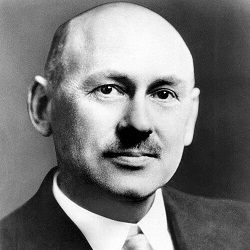
Robert Goddard (see the second photo on the left) =>
ushered in the Space Age in the United States. He was ahead of both Nazi Germany and the USSR. But he did not live to see practical realization of his dreams and investigations. He died in 1945, rejected by society, forgotten and humiliated by journalists.
The Soviet dreamers were more fortunate. Stalin liked the idea of sending his son, Vasily Stalin, into space. And in 1946, in the war-ravaged USSR, the Soviet space program was launched.
2. Great Space Race.
On October 4, 1957, the Soviet Union launched the first artificial Earth satellite. And only then did the Americans realize the importance of space exploration. The era of spaceflight began, and the Great Space Race commenced.
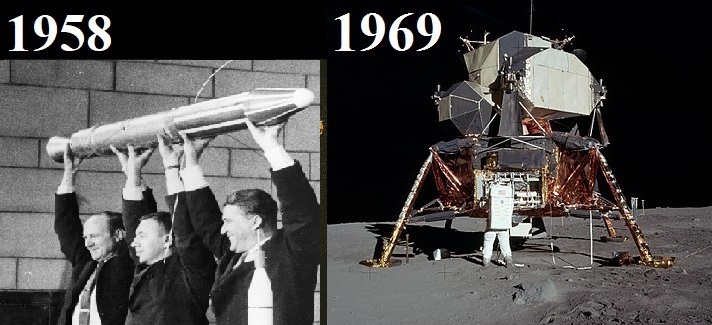 The dawn of the Space Race between the two space powers—the USSR and the USA—spanning the years 1957 to 1969, marked the golden decade of space flight.
In less than 12 years, humanity traveled the path from the launch of the first artificial Earth satellite (USSR, 1957) to the landing of a human on the Moon (USA, 1969).
Left: the first USA artificial satellite (1958), Explorer-I (mass: 8.3 kilograms), and the lunar module "Eagle" (mass: 15 tons)—which, 12 years later, would land on the surface of the Moon.
Now that's what rivalry means !
The First Run of the Space Race : Who Will Be the First to Launch a Human into Space ?
The Soviet Union won this race. Yuri Gagarin - the first human in space - was a citizen of the USSR. The date was April 12, 1961. The flight was orbital, consisting of a single orbit. Four months later came the second flight, lasting over 24 hours and covering 25 orbits. The spacecrafts weighed 4,700 kg. The United States lagged behind by a year; their first orbital flight did not take place until February 20, 1962. It lasted five hours, covered three orbits, and the spacecraft weighed 1,350 kg.
The Second Run of the Space Race : Who Will Be the First on the Moon ?
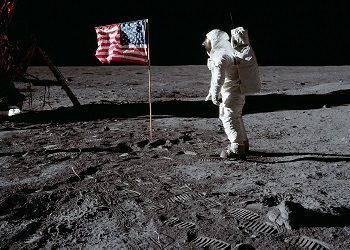
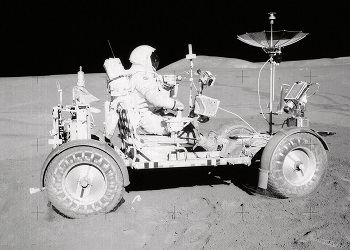
The Soviet Union was leader the second space race until 1966: the first multi-seat flight (1964), the first spacewalk (1965), and the first soft landing of an automated probe on the surface of the Moon (1966). The United States was always second.
But. . . in 1965, the leaderships of the USSR deemed space projects mere fantasies and cut funding for Soviet space programs. Manned lunar and interplanetary programs in the USSR were shut down. The era of space dreamers in Russia had come to an end. At a time when John F. Kennedy declared a lunar landing is a priority of American policy. And on July 20, 1969, American astronauts Neil Armstrong and Edwin Aldrin became the first to set foot on the surface of the Moon.
The second space race has ended. And with it, the space rivalry between the two superpowers has also come to a close. Manned lunar and interplanetary programs were shut down in the United States as well. The "Apollo" lunar program was never fully completed, and NASA's budget was slashed twenty-five-fold!
And yet, in 1971, the Soviet Union was planning to carry out its first interplanetary flight to Mars - without a landing on its surface. A launch date was set: June 8, 1971. The flight was expected to last three years.
In 1974, the United States planned to undertake an interplanetary mission to Venus that did not involve a landing on its surface. The duration of the flight was to be one year. An orbital interplanetary module had already been constructed for this mission (it was subsequently utilized as the Skylab space station).
The descent modules of both the Soyuz and Apollo spacecraft were designed to return to Earth at escape velocity following interplanetary expeditions. Both nations planned to land on the surface of Mars before 1980.
But they did not fly, and they did not land.
Perhaps it is a blessing that they didn't fly. Had they done so, there is a 90% chance that both expeditions would have ended tragically—the cosmonauts would not have survived the flight.
Thus, the first step in space exploration was taken by dreamers; yet, once the practical utility of space research became apparent, pragmatists entered the race—and simply overwhelmed the dreamers with money: in the post-war era, the U.S. economy was many times larger than that of the USSR.
But the race is not over yet. It was merely postponed for 50 years. A third, final run remains:
Who will be the first on Mars ?
Who lined Up at the Start ?
There are four government space agencies :
- NASA (USA),
- ESA (EU),
- CHSA (China),
- RosCosmos (Russia).
These four government agencies will most likely merge.
USA(NASA) + ESA(EU).
CHSA(China) + RosCosmos(Russia).
The forces will be roughly equal.
There are private space companies :
- SpaceX (Elon Musk, USA) =>,
- Blue Origin (Jeffrey Bezos, USA) =>,
- Virgin Galactic (Richard Branson & Burt Rutan, USA) =>.
And about fifty space projects, developed and promoted by government institutions, private companies, and groups of enthusiasts worldwide. => :
"Mars Direct" =>
"Mars One" =>
"Mars Foundation" =>
"Mars Design Reference Mission" =>
. . .
We are the dark horse in this race. No one knows about us. We have nothing. We have no money, but we have experiments and ideas that no one else has !
Why are we confident in this ? Because :
This will be the most amazing competition in the history of humanity. !
Manned flight to Mars is the ultimate goal of our AG project. It is not fantastic. We are sure this is more really then flights to Mars planned by the NASA or anyone today.
Why are we sure in it ?
3. Why Won't Our Rivals Reach Mars?
(Problems of Manned Interplanetary Expeditions)
3.1. Engines
Rocket engines are the heart of any space project for an expedition to Mars. A manned mission to Mars with a landing on its surface cannot be accomplished using chemically powered rockets. Although there are plans for a Mars mission that involve chemical propulsion, a detailed examination of these plans reveals their practical impossibility.
It's estimated that such a mission would require assembling a spacecraft weighing approximately 4,000 tons in low Earth orbit. This is ten times heavier than the International Space Station (ISS), which took over a decade to build. Will we be designing a space rocket for 100 years?
An expedition to Mars requires fundamentally new engines. The Russian engineer A. Fedorov was the first to realize this.
 Nuclear ?
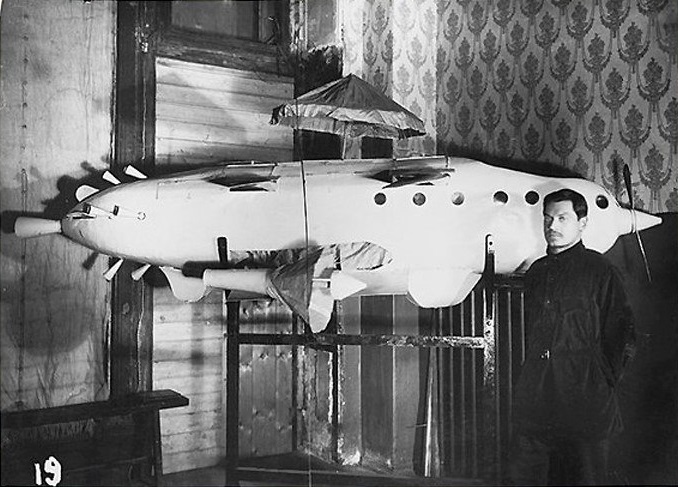
At a Moscow exhibition in 1927, Alexander Ya. Fedorov presented a 1:20 scale model of a nuclear rocket ship (pictured left is a photograph of Fedorov's ship model alongside its creator).
He was the first to propose using nuclear engines for a flight to Mars - a fantastic visionary insight, given that at the time, even Ernest Rutherford believed that nuclear reactions could not be utilized for practical purposes.
That was one hundred years ago. Following him, the ideas of utilizing nuclear engines were devoloping Stanisław Ulam and Frederic de Hoffmann, Qian Xuesen, Leslie Shepherd and Val Cleaver.
In 1959, the United States and the USSR began the technical development of nuclear space engines.
Yet, even now - 100 years later - a spacecraft powered by a nuclear engine is still under development.
In reality, such a vessel capable of a manned flight to Mars will not be ready for another 30 years. Assuming everything proceeds according to today current plans.
Today, work on the use of nuclear propulsion in space is being conducted in the United States, Russia, and China.
As of today, spacecraft with nuclear propulsion have not even been tested in space. Ground-based bench tests only. Just like 60 years ago, when they began in the USA and the USSR. And when it was anticipated that nuclear engines would be used in space in 10 years. The plans and еimelines remain the same today. :-)
 USA (today).
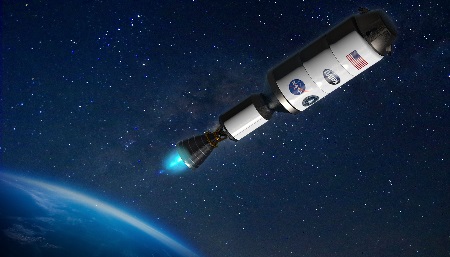
In February 2018, reports emerged that NASA was resuming research and development work on a nuclear rocket engine.
The DRACO project, aimed at developing a nuclear propulsion system for a mission to the Moon.
The first test flight into space is planned for December 2028 with a capacity of more than 20 kilowatts. If the preparations for the flight of automated probes to Mars will be not completed in that time, we will have to wait two and a half years.
But anyway for a manned flight to Mars, an engine 100 times more powerful is needed.
This will be a third-generation engine. And it won't be ready before 2050.
Russia (today).
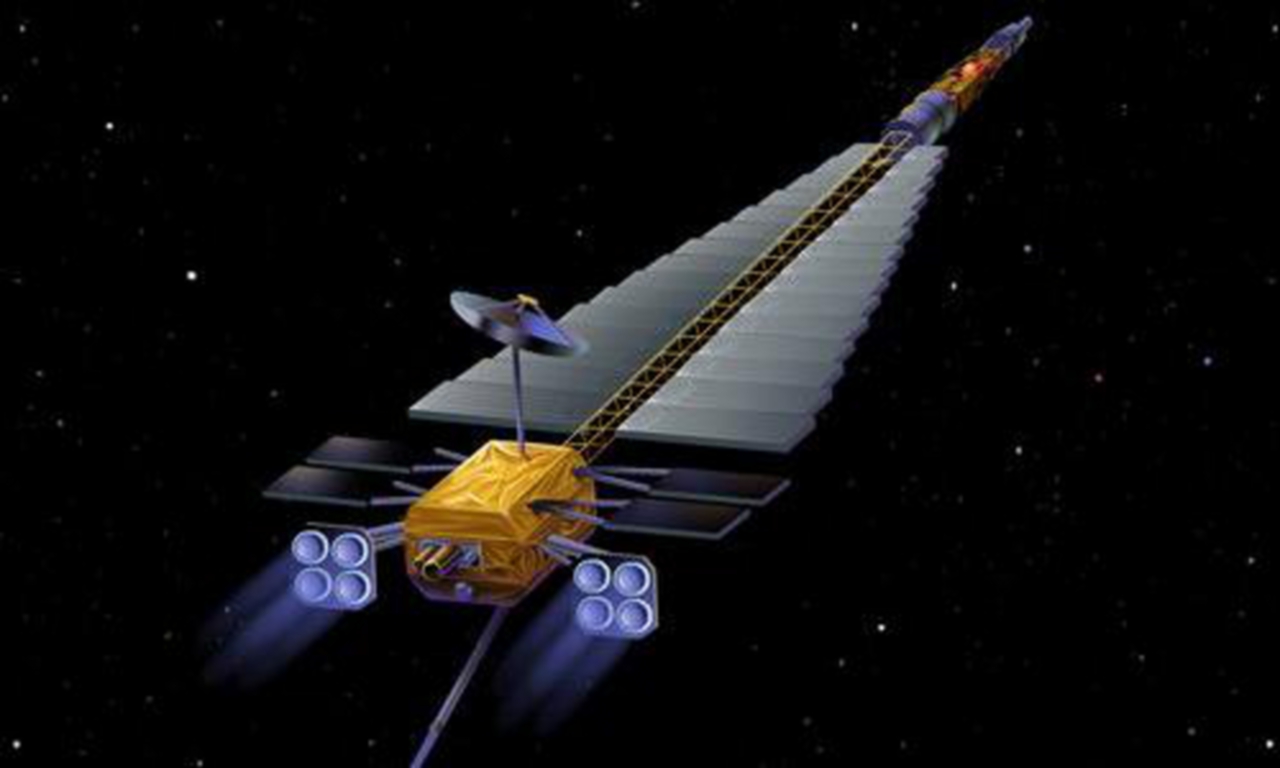
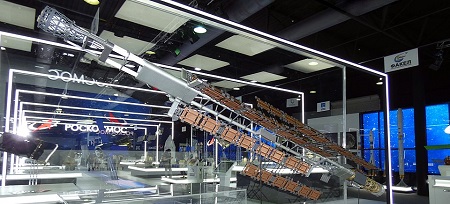
Russian space tug "Nuklon" (pictured left: the first illustration depicts "Nuklon" as it will appear in space; the second image shows the spacecraft under assembly at an exhibition). The power output of its propulsion system is 100 kW, thrust is 6 Newtons, specific impulse is 100 km/s, and operational lifespan is 2,400 hours.
Its maiden flight is scheduled for no earlier than 2030. In 2035, a mission is planned to deliver automated probes to Mars, and subsequently to Jupiter. But it will be capable of delivering a mere 10 tons of cargo into lunar orbit. (This is one and a half times less than the mass of the "Eagle" lunar module, which landed on the Moon in 1969. In other words, this space tug would not even be sufficient to carry out a human landing on the Moon.) Furthermore, this is approximately 20 times less than the minimum mass required for a spacecraft undertaking a crewed mission to Mars. Consequently, a mission to Mars would necessitate a nuclear space tug of the next—second or even third—generation, the design of which has not even begun yet. According to the most optimistic projections, such a tug could not be built until 2070.
3.2. Flight duration.
Cosmonauts will not survive the conditions of a prolonged interplanetary expedition. A mission to Mars will take between one and a half and two and a half years. One and a half years in weightlessness, exposed to harsh cosmic radiation. . . The expedition participants simply will not be able to withstand it. A agonizing death awaits them during the mission.
3.3. Enormous risks.
Neither backup nor duplicate expeditions are provided for in any of the projects. Even on the ISS, astronauts in low Earth orbit often require assistance from Earth. The slightest error during a flight to Mars, and no one will be able to help the astronauts. . .
3.4. The cost of an expedition to Mars.
The cost of an expedition to Mars would be hundreds of times greater than that of the lunar program, and tens of times greater than that of the International Space Station. Such an expedition would require trillions of dollars. No single country is capable of financing a project of this magnitude on its own. Moreover, humanity as a whole currently faces other, more pressing challenges. The ISS project has failed to justify its existence in orbit—whether from a scientific, economic, or political standpoint. Consequently, no one is going to invest funds in yet another "financial monster" of the space age.
3.5. Conclusions :
Even a cursory review of proposed manned missions to Mars ( =>) reveals that, with current technologies, a flight to Mars involving a landing on its surface is unfeasible.
For scientific research, however, there is an excellent alternative: automated interplanetary probes. They are hundreds of times cheaper, entail no risk, and—most importantly—yield returns in the realms of science, economics, and politics alike. As for manned interplanetary flights, we will have to wait; humanity is not yet ready for them.
The use of homotechnologies represents a realistic project for a manned expedition to Mars—realistic from every conceivable standpoint. We plan to carry it out in 30 years. Before then, no one else will manage to land on Mars ahead of us.
4. What is our project based on ?
To carry out an expedition to Mars, we require a large-scale antigravitational (A.G.) shield.
In our experiments, we have demonstrated the feasibility of creating an antigravitational shield.
Our theory of antigravity (See Antigravity Theory =>) enables us to calculate the necessary parameters for such a shield.
Creating an A.G. shield requires a substantial quantity of "red projection powder." This constitutes the primary challenge facing our space project.
We hypothesize that we will be able to develop the means to transfer antigravitational properties to other substances. (See Transfer of Anomalous Properties =>). If this is confirmed, we will be capable of creating large-scale anti-gravity shields. And then, an expedition to Mars will become merely a technical problem—one for which we will be able to state precisely when we can carry it out and how much it will cost.
5. How do we plan to carry out a manned expedition to Mars ?
5.1. Interplanetary Ships.
This will be a new type of Iшnterplanetary spacecraft. It must possess the following essential components:
1. The antigravity shield.
2. The Homo-Energetic propulsion system.
3. The Homo-Impulse engine.
Without these elements, a flight to Mars is unfeasible. The development of each of these three components is currently at the stage of detecting faint physical effects — effects that merely demonstrate the fundamental feasibility of their creation. We have allotted a timeframe of 30 years for the realization of the project: a manned mission to Mars.
The antigravity shield.
This is the primary element of the AG spacecraft. Such a spacecraft must be assembled on the surface of the Earth and launch from the surface. It must also land on the surface of Mars as a complete unit.
The Homo-Energetic propulsion system.
This must be the spacecraft's propulsion system.
The Homo-Impulse engine.
This must be a power plant to support the crew's life support systems.
Our project entails the construction of two identical spacecraft - "Robert Goddard" and the "Wernher von Braun" - for a mission to Mars. Each vessel is designed to accommodate an eight-member crew (featuring four cabins, each capable of housing two people); however, in practice, only four individuals will fly aboard each ship—one person per cabin. The remaining four berths will be reserved as backup accommodations, should it become necessary to rescue the crew of the other vessel.
The spacecraft will be assembled on Earth. Launches from Earth and other celestial bodies—as well as landings on planetary surfaces—will be executed using the ships' onboard anti-gravity shields.
Each cabin is equipped with a shower capsule and a private restroom. In addition to the crew cabins, the spacecraft will feature a command bridge, a greenhouse, a wardroom, a galley, and a medical bay.
The first spacecraft, the "Robert Goddard", will undertake its maiden voyage to Mars in autonomous mode. It will deliver 100 tons of equipment to the Martian surface—specifically, a habitat module, a three-year supply of food and water for four people, and a small anti-gravity craft designed for atmospheric flight and exploration of the planet. Afterward, it will return to Earth to serve as a backup vessel, standing by in the event that a rescue expedition becomes necessary. The second spacecraft, the "Wernher von Braun", will transport the first four human crew members to the Martian surface, along with a second anti-gravity craft for Martian flight and other essential equipment. All four crew members will disembark on Mars to establish a permanent residential outpost and will spend approximately two months on the planet's surface. During this period, two cosmonauts will remain at the base, while the other two conduct short expeditions aboard the anti-gravity craft to explore the Martian terrain. The second anti-gravity craft will remain behind to serve as a safety backup.
These two anti-gravity spacecraft will fly to Mars alternately, ensuring a permanent human presence there. Each new expedition will deliver 100 tons of new equipment.
Members of the Mars expedition under the project will be recruited from participants in the Homotechnologies project who have worked on one of its initiatives for at least five years.
5.2. Landing Site.
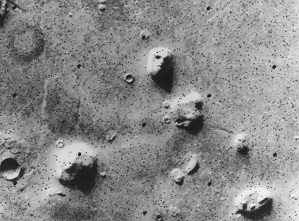
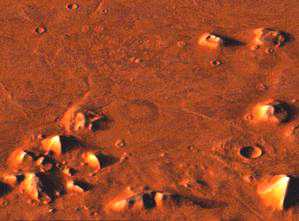
The landing on Mars will take place in Cydonia (on the left is a 3D reconstruction of the Cydonia region, created based on photographs from the "Viking" missions). Why there ?
The landing on Mars will take place in Cydonia (on the left is a 3D reconstruction of the Cydonia region, created based on photographs taken by the "Viking" missions). Why there?
Everyone has heard about the "Face" on Mars (see Wikipedia =>)
The problem is that it is impossible to put the matter of the "Face" to rest once and for all. All the photographs of the "Face" that we possess come from NASA. NASA receives them via its own antenna arrays; no one else possesses such antennas. Consequently, no one is able to intercept these images. The photographs are received in digital format; they pass through filters, and they can easily be retouched and distorted in any desired manner. Therefore, we are compelled to take NASA at its word.
However, beyond the "Face" in Cydonia, several other "faces" have also been discovered:
A second one was identified in Viking photographs located not far from the first (image 70A11 from "The Case for the Face").
A third—the "Meridiani Face"—was discovered in 2007.
All these "faces" are explained away as an effect of pareidolia (a visual illusion in which human faces are perceived within random patterns). Yet all these faces share the same orientation and exhibit similar surface features; explaining this as mere coincidence is difficult.
Therefore, we will land in Cydonia, as it is the most interesting and enigmatic location on Mars.
The "pyramids" in Cydonia were discovered via telescopes in the early 1970s—even before the "Viking" missions. Consequently, this region was selected as the primary landing site for "Viking 1" in 1976. However, "Viking 1" first entered orbit around Mars to acquire more detailed imagery of the prospective landing zone than what had been obtained through Earth-based telescopes. Yet, when the designated landing site in Cydonia—alongside the "pyramids"—revealed the presence of a "face" as well, NASA leadership urgently relocated the "Viking 1" landing site.
Cydonia was initially regarded as the most intriguing and promising location for the first landing of robotic spacecraft on the Martian surface; yet, even today—50 years later—NASA has not dispatched a single research probe to this region.
5.3. Flight trajectory.
The duration of an expedition to Mars is determined by the flight trajectory.
Flight trajectories using chemical propulsion are long, and consequently, the journey will be lengthy.
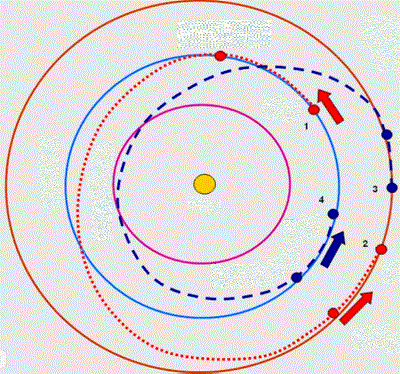 Flight Trajectories with Chemical Engines.
A flight to Mars can follow various trajectories :
- Elliptical — with its perihelion at Earth and aphelion at Mars;
- Parabolic;
- Hyperbolic;
- Trajectories involving a gravity assist maneuver utilizing Venus. One such trajectory is shown in the figure on the left.
The rule for all trajectories is simple: the lower the fuel consumption, the longer the expedition will last. The one-way flight time to Mars varies from 3 to 12 months. The total duration of the expedition ranges from 1.5 to 2.5 years. However, all flights are conducted along curvilinear trajectories.
The drawing (left) shows as an example one of them trajectories and just how long and convoluted the flight trajectories to Mars would be using conventional engines.
Antigravitational Trajectories.
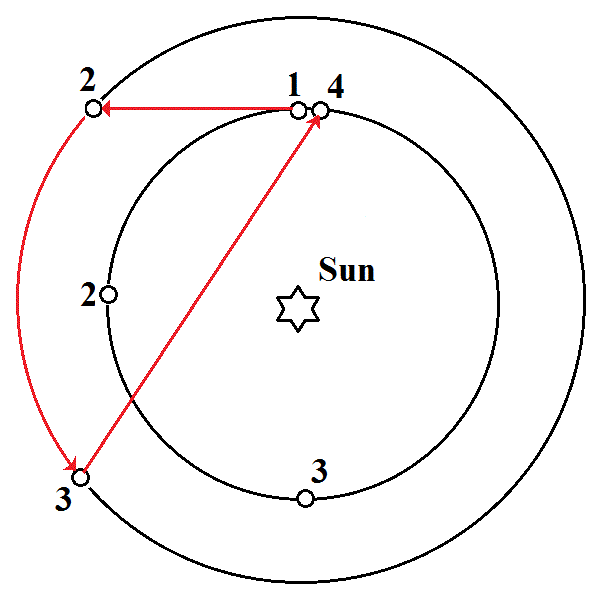 Antigravity screens enable us to travel through space along straight trajectories, leveraging Earth's orbital velocity; as a result, the travel time to Mars is reduced to 30–60 days—faster than via any other trajectory. Currently, missions to Mars can only be undertaken once every 2.5 years, as the relative alignment of Earth and Mars repeats on this cycle. With the aid of antigravitational screens, however, we face no such constraints; flights will proceed along a straight line, allowing space expeditions to Mars to be launched at practically any time.
5.4. Duration of the space expedition.
We plan to complete the entire expedition in less than five months:
2 months — Flight from Earth to Mars.
1 month — On the surface of Mars.
2 months — Return from Mars to Earth.
If it proves possible to develop powerful propulsion systems of the homo-impulse type, the entire round-trip expedition to Mars will take 1–2 months.
On the ISS, some cosmonauts have spent more than a year aboard orbital stations and have tolerated weightlessness quite satisfactorily. However, we also allow for the possibility of generating artificial gravity by rotating the living quarters of an interplanetary spacecraft.
5.5. Expedition Risks.
We plan to construct two identical anti-gravity spacecraft for the Mars expedition, ensuring that we are able to dispatch a rescue mission at any moment. Every stage of our program will be backed by a contingency plan—to address potential emergencies—as well as a comprehensive rescue plan for the entire astronaut crew.
By utilizing anti-gravity platforms, we will be able to construct massive, large-scale interplanetary spacecraft equipped with both shielding against cosmic radiation and artificial gravity.
5.6. Expedition Cost.
We estimate the cost of our expedition at 5 billion dollars. Experience tells us that the actual cost of any scientific project typically exceeds the initial budget by a factor of three to four. Very well! Let it be 20 billion dollars! That is a modest sum; the International Space Station cost more. We intend to fully fund this project using our own resources, drawing upon profits generated by accurate predictions of stock market behavior (See Stock Market Trading =>).
Any additional assistance—whether in the form of government grants or voluntary private donations—would certainly aid in the project's realization, but it would in no way affect the feasibility of its execution. The guiding principle of our project is this: we must rely solely on our own strength.
5.7. The Problem of Radiation.
One of the major challenges in the exploration of the Solar System is the problem of cosmic radiation. Homotechnologies offer two potential avenues for its solution:
- It is hypothesized that the regular intake of "projection powders" doubles the human body's resistance to radiation.
- It is possible that anti-gravitaty shields could also generate force fields capable of protecting humans from cosmic radiation.
At present, both of these proposals must be regarded merely as hypotheses, requiring further in-depth investigation.
6. Flight to Mars using the AG Project.
Flight to Mars using the AG technology will take place in a completely different way than flying to Mars using missiles with chemical engines.
| Anomalous Gravity Project | NASA Project | |
|---|---|---|
| 1 | The spacecraft is completely assembled on the surface of the Earth | The spacecraft is assembled on the Earth orbit from separate blocks those are interconnected. |
| 2 | The spaceship starts from the surface of the Earth | The spacecraft starts from the orbit of the Earth |
| 3 | The flight to Mars goes in a straight trajectory and continues 2.5 months | The flight to Mars takes place on an elliptical trajectory and continues 8 months |
| 4 | The entire spacecraft lands as a whole on the surface of Mars | Only a lander module will lands on the surface of Mars |
| 5 | 10-30 tons of useful equipment are delivered to the surface of Mars | Only 0.3 - 1.5 tons of useful equipment will be delivered to the surface of Mars |
| 6 | The entire crew of the expedition (4-6) works on the surface of Mars | Only several people (2-4) from the entire crew (4-6) of the expedition work on the surface of Mars |
| 7 | The expedition on the surface of Mars continues 2-10 months | Expedition on the surface of Mars continues 4-20 days |
| 8 | Cost : ~ 3-5 billions | Cost: > 1,000 billions |
| 9 | Probability of success : > 95% | Probability of success : ~ 50% |
From the comparison it is clear that the scientific effectiveness of the expedition to Mars using the AG technology will be hundreds of times higher than the expedition to Mars with chemical missiles. If a flight to Mars with chemical missiles is complete nonsense, and a waste of money, then a flight to Mars using the AG technology is a logical step forward in the development of human civilization.
To implement Flight to Mars using the AG technology, the following scientific problems must be solved :
7. The AG Project problems.
| Number | Description | Kind of Work | Conclusion |
|---|---|---|---|
| 1 | Show the possibility of screening of the gravitational field. | Experimentally | Done |
| 2 | Show the possibility of 100% shielding of the gravitational field. | Experimentally | Done |
| 3 | Carry out 100% shielding of the gravitational field. | Experimentally | Processing |
| 4 | Show the possibility of strengthening the gravitational field. | Theoretically | Unknown |
| 5 | Carry out the strengthening of the gravitational field. | Experimentally | Unknown |
| 6 | Show the possibility of creating a power screen shielding any external radiation | Theoretically | Unknown |
| 7 | Show the possibility of creating a power screen shielding any external radiation | Experimentally | Unknown |
| 8 | Show the possibility of creating a power plant | Theoretically | Unknown |
| 9 | Show the possibility of creating the power plant | Experimentally | Unknown |
| 10 | Show the practical feasibility of creating the power plant for a spacecraft | Experimentally | Unknown |
Of these 10 points, you can actually make 1-3. The rest are under questions. If all 10 will be implemented, then the colonization of planets of the solar system will go by leaps and bounds. If we manage to carry out only 1-3, then we can carry out only a few flights to Mars and create a permanent station on the Moon.
Yes, the AG Mars project has a lot of problems. But these are scientific problems. Scientific problems do not require a lot of money. They can be solved by several people at their working desks. If they will be solved, then flying to Mars will be an interesting, cheap and safe trip.
There are two kind of problems :
- Scientific.
- Technical.
Scientific problems are :
- To prove the existence of the effect of gravitational shielding.
- To prove the possibility of 100% gravity shielding.
- To show the possibility of producing powders for gravitational shielding in large quantities.
- To show the possibility of shielding cosmic radiation by powders of projection.
If these four problems will be resolved, then only money will be needed to fly to Mars.
8. Phased Plan for Conducting a Manned Expedition to Mars.
Work on carrying out a flight to Mars comprises three stages:
Stage One.
Preparation of the scientific foundation.
Stage Two.
Validation of scientific findings. This stage is to culminate in the creation of a small automated spacecraft equipped with an anti-gravity shield, which will be launched into space.
Stage Three.
Scaling up the results of the second stage to a magnitude sufficient for the creation of manned spacecraft equipped with anti-gravity shields for a flight to Mars.
9. Problems with Our Proposed Mission to Mars.
The colonization of Mars using "homotechnologies" resolves all major issues: reliability, safety, and relatively low cost. However, there are two fundamental problems:
1. We must create a shield capable of completely—100%—blocking a gravitational field.
2. This anti-gravitational shield, providing 100% shielding, must be of substantial size (on the order of 1,000 square meters).
How can these problems be solved?
The gravitational shielding effect does exist, but currently only at a level of 0.1%.
The powders required for this shielding can be produced, but only in quantities of a few grams per year.
In other words, the effects are real, but they need to be amplified—somehow—a thousandfold. If we can resolve these scientific challenges, the remaining technical and financial issues will present no further difficulties.
To solve these problems, we must:
1. Investigate the properties of these "projection powders" with the aim of enhancing their characteristics.
2. Organize a nationwide search for individuals capable of producing these "paranormal substances."
3. Learn how to transfer the unique properties of these paranormal substances to other materials—materials that can be produced through technical means in unlimited quantities.