Ancient World
www.HomoTechnologies.com (Main Page) =>
I n d e x:
1. The Role of Prior Experience in Studying the Projection Powders.
1. What connection do modern long jumps or running have to the culture of the Indus Valley Civilization of the third millennium BC, or to ancient statues?
2. The development of human paranormal abilities is, first and foremost, a matter of experience—experience passed down from generation to generation. Consequently, if we wish to investigate and utilize anomalous human capabilities in sports, yet lack direct experience ourselves, we must turn to history. Today, we possess no schools or institutions that engage in the practical study of these matters. Such institutions do not exist simply because there are no established examples of positive results.
3. This path raises a multitude of questions to which we currently have no answers. It is therefore natural to turn to history—specifically, to the experience of the ancients. Is there any evidence of such phenomena in the past?
We seek answers to the following questions:
1. What athletic results are attainable?
2. How can these results be achieved?
3. What are the criteria for such achievements?
4. Where should we look for evidence that might provide clues to the answers to these and other questions?
Here, sculptures and drawings that have survived to the present day offer us valuable clues. However, personal experience is equally vital; without it, one cannot discern the significance of these clues.
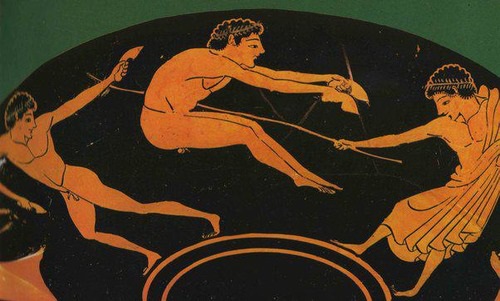 4. For instance, an ancient Greek vase depicts an athlete performing a long jump. The image portrays a nude athlete who appears—to us, at least—to be wearing a thin belt. While this assumption is certainly open to debate, a similar belt is also depicted on a clay seal from the Indus Valley Civilization (see Fig. 8). On that particular seal, the belt is clearly visible.
We hypothesize that such belts were worn by athletes in antiquity to secure "Projection Powders" against their lower backs.
Furthermore—as suggested by the seal—Yogis may have worn these belts to induce states of levitation and to manifest other paranormal abilities.
5. On an ancient Greek vase, the role of a woman—who is depicted holding a rod that touches an athlete's body—remains enigmatic and unclear. We hypothesize that this represents a technique, currently unknown to us, that was employed during the long jump. According to the rules of ancient Greek athletic competitions, athletes were permitted to utilize auxiliary aids during their jumps. For instance, they employed special weights known as *halteres* (visible in the depiction of two athletes on the vase), which they held in their hands and swung backward during the jump to increase their horizontal velocity. We suggest that the involvement of the woman—which, too, may have been a permissible practice—constitutes yet another technique currently unknown to us: the transfer or augmentation of the athlete's momentum through the use of a rod.
However, this hypothesis requires experimental verification—a process that we can only undertake by working directly with athletes.
2. Sport in the Ancient World.
Why did the ancients know more about anomalous human abilities than we do today?
1. We believe that athletic achievement is, above all, a matter of practice and the continuity of accumulated experience in training the human body. A single athlete who draws upon the coaching wisdom passed down through dozens of generations will achieve far more than tens of thousands of athletes who lack such a wealth of experience behind them.
2. In this sense, the experience of ancient athletes is unique: The history of the Olympic Games in Ancient Greece spans a thousand years, whereas the modern Olympic Games are less than 150 years old. Yet, beyond their athletic expertise, the Greeks also drew upon a tradition of human physical training cultivated within esoteric schools—a tradition that dated back thousands of years. For this reason, we are convinced that the athletes of Ancient Greece would easily surpass their modern counterparts.
3. In the ancient world, sport was something more than mere athletics. The military might and economic power of a state depended directly upon the physical strength of its citizens.
4. The earliest texts mentioning "Projection Powders" appeared over two thousand years ago. In these writings, the authors refer to certain secret societies that worked with these substances—the very societies from which the authors themselves acquired their knowledge.
When did these societies first emerge, and how long might the chain of their accumulated experience actually be?
One specific indicator of the knowledge regarding Projection Powders is the phenomenon of testicular transformation in an adept.
A seal discovered at Mohenjo-daro provides evidence that this knowledge already existed as early as the 3rd millennium BC. This knowledge was also present in Ancient Greece and Ancient Egypt. But did a chain of continuity exist linking the ancient Indus Valley Civilization with Ancient Greece? While there is no documentary evidence to support this, we hypothesize that such a connection existed, for the following reasons:
The ability to induce a change in the testes can be achieved only through the practice of yoga or similar specialized techniques. In our view, attaining this level of mastery—without any prior experience—would require several hundred years of continuous instructional practice. In any case, historical records offer no evidence to suggest that this knowledge emerged independently in disparate, unconnected regions. The Indus Valley Civilization was built upon an earlier Dravidian culture, from which it most likely inherited its body of knowledge—including the practice of yoga. In Ancient Greece, there is no evidence whatsoever of the existence of societies of this nature. However, it is well known that the Greeks drew their philosophical concepts from the esoteric schools of Ancient Egypt. And Ancient Egypt, in turn, maintained ties with the Indus Valley Civilization.
Therefore, in our opinion, the chain of succession unfolded as follows:
Dravidians -> Indus Valley Civilization -> Ancient Egypt -> Ancient Greece.
We, too, acquired our knowledge not through our own personal experience, but rather through the accumulated experience of yoga teachers, Russian Masons, and the literature that has come down to us.
3. The Achievements of Athletes in Ancient Greece.
1. Records have survived concerning the ancient Greek athlete Chionis of Sparta. The Greek historian Sextus Julius Africanus (who died after 240 AD) wrote of a jump performed by the Spartan Chionis in 664 BC, covering a distance of 52 feet—which, by modern standards, amounts to 16.66 meters.
2. This was not an isolated incident. Phayllus of Croton, competing at the Pythian Games in Delphi (circa 500 BC), jumped 55 feet—16.76 meters (the Pythian foot measured 30.48 cm). The Greek philosopher Theophrastus (372–287 BC), a student of Aristotle, described Phayllus's jump as follows: “This man flew clean over the "skamma" (the landing pit, which was 15.25 meters long) and, striking the rocky ground beyond it, broke his left leg.” Phayllus's jump was so astonishing to his contemporaries—the landing pit, after all, was not designed to accommodate such a leap—that a stele was erected in his honor, bearing an inscription describing his feat.
3. Let us note a point of particular significance to us: such jumps were exceedingly rare. Records have reached us regarding only two such jumps throughout the entire thousand-year history of sports in Ancient Greece. Unfortunately, we do not know the ages of Chionis and Phayllus at the time they performed these jumps. This detail is crucial, for according to our current understanding, such results could only be achieved by an athlete whose body was producing the "Red Powder of Projection." And this phenomenon manifests only with age—specifically, not before the age of 35. Indeed, the results achieved by Chionis and Phayllos serve as evidence that athletic records—when aided by the use of "Projection Powders"—can indeed "age".
4. Such an astonishing result seems impossible by today's standards; consequently, sports historians have proposed the following explanations:
- Heroic exaggeration (the authors who wrote about these feats lived long after the athletes themselves and based their accounts on recollections passed down to them).
- The competition was actually a triple jump.
- A misinterpretation of ancient Greek units of length.
However, an analysis of these claims easily demonstrates their untenability. The fact that stelae were erected in the athletes' honor, that the jumping pit was not designed to accommodate such a leap, and that their names were remembered for hundreds of years—all of this testifies that these records were considered extraordinary even in their own time.
5. The long jump is not the only event in which ancient Greek athletes achieved astonishing results. For instance, only runners capable of catching a hare were permitted to compete in the short-distance sprints at the Olympic Games. To ensure a fair test, the hares were released into a straight corridor so they could not zigzag while running. Zoologists assert that hares consistently run at a speed of 13 meters per second. This implies that ancient Greek athletes were capable of running the 100-meter dash in under 8 seconds.
There are films depicting how, even today, men in certain African tribes are able to catch hares. However, these films clearly show that they succeed in catching the animal because the hare runs in a zigzag pattern, while the runner pursues it in a straight line, effectively cutting across the loops in the hare's path.
4. Evidence of Testicular Replacement in the Ancient World.
1. In our view, the achievement of extraordinary records requires the Red Projection Powder, having reached a specific stage of maturation. The Red Projection Powder is produced within the human body. The criterion for the production of this Red Powder at the requisite stage is a specific change in a man's testicles.
But was this fact known in antiquity?
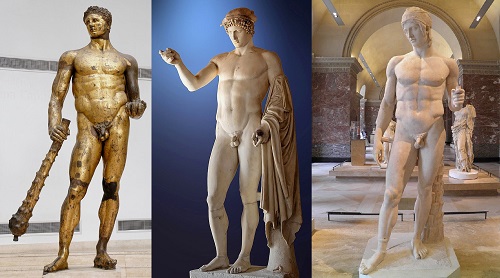 2. The sculptures of Greek athletes serve as evidence that they were indeed privy to this secret regarding the Projection Powders. In statues depicting certain outstanding ancient Greek athletes, one can observe that the right testicle is positioned lower than the left. In all statues depicting ordinary nude individuals, the testicles are depicted anatomically correctly—the left one is larger and hangs lower than the right.
Ancient sculptors possessed a thorough understanding of human anatomy. In Ancient Greece, there existed a cult of the nude body; thus, it is inconceivable that sculptors would have committed such an error by accident. This deviation must have held some specific significance.
Heroes and gods were frequently depicted with the right testicle positioned lower than the left. In photographs of these sculptures we observe this characteristic—the lowered right testicle—in depictions of:
- Hermes, the patron of esoteric knowledge;
- Ares, the god of war.
Therefore, in our opinion, the depiction of a lowered right testicle in the sculptures of certain athletes served to underscore their exceptional physical capabilities and their heroic status.
 3. In Ancient Egypt, on the majority of hieroglyphs depicting the male sexual organ, the right testicle hangs lower than the left and is also larger in size.
(See ancient Egyptian hieroglyphs in the book: Ruth Schumann Antelme and Stephane Rossini, *Sacred Sexuality in Ancient Egypt*, English translation, 2001.)
4. It would be interesting to trace the specific nuances in the usage of ancient Egyptian hieroglyphs featuring various depictions of hanging testicles.
5. The specific positioning of the testicles—serving as a key indicator of a person's physical capabilities—was recognized long before the advent of our modern civilization. The reason for this is clear: in the past, a person's physical prowess determined their destiny and social standing, and was of paramount importance to society. Consequently, techniques for physical training and the development of human physical capabilities constituted the "high technology" of antiquity. Over millennia of refining these techniques, ancient peoples may well have attained a level of mastery exceeding that of our own civilization. Therefore, we do not claim to have discovered anything fundamentally new here; rather, we are merely reconstructing knowledge that we have lost. The following archaeological discovery serves to illustrate the significance attributed to this criterion in ancient times:
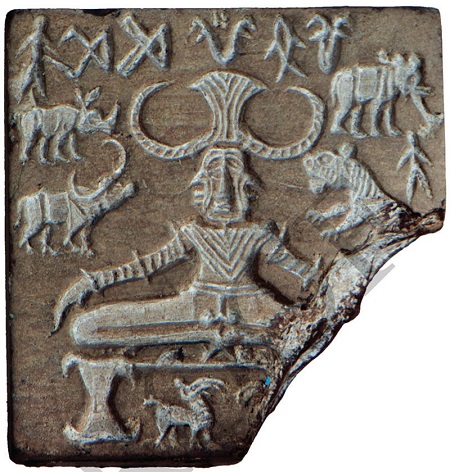
6. During excavations of the ancient Indian city of Mohenjo-Daro in 1922, a clay seal belonging to the ancient Indus Valley Civilization (3300–1900 BC) was unearthed. This seal is currently housed at the National Museum of Natural History in Washington, D.C.
7. It is believed that the seal depicts a certain god (whom scholars have tentatively named "Proto-Shiva"), who subsequently evolved into the Hindu deity Shiva - the patron of yogis.
8. The text and symbolism on the seal remain undeciphered to this day. However, on it, we observe the very detail that interests us: the right testicle is larger than the left and hangs lower in relation to it. It remains unclear whether the god or yogi depicted on the seal is levitating or not.
5. The Egyptian Pyramids.
5.1. What are Egyptian Pyramids ?
 When we discovered that it is possible to influence the future, a question arose:
Is someone, perhaps already influencing our humanity today?
Since we are convinced that the technologies we have discovered were known and being developed many thousands of years ago (See =>), it was obvious to us that this must be the case.
But is there any evidence of this?
What can our research tell us about this?
Our research indicates that, in order to influence people in the future, and, through them, the course of human history, it is necessary:
1. To create a device that is guaranteed to exist at the specific moment in time we wish to influence. A similar device is also required to maintain instantaneous informational contact with civilizations located many light-years away from our Sun.
2. It is essential that the people we intend to influence be aware of this device. They need not know its purpose, but their consciousness must be linked to it. Without such a link, we will be unable to access their subconscious.
The question is
The Egyptian pyramids satisfy these all conditions.Do objects exist on Earth that:
- Were created before the emergence of our technotechnological civilization.
- Objects that are guaranteed to have endured for thousands of years and, in all likelihood, will continue to exist.
- That are known to everyone?
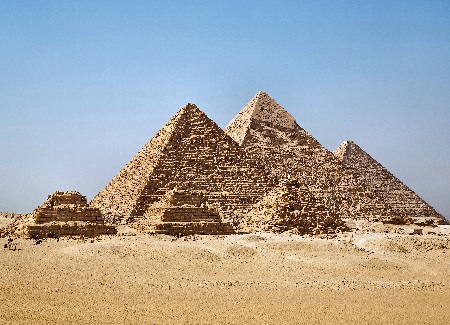
The Egyptian pyramids satisfy these all conditions.
So, perhaps the Egyptian pyramids are not historical monuments of antiquity, but technical devices that are actually functioning today, through which certain civilizations monitor and control our own civilization? Or through which someone on Earth establishes contact with other extraterrestrial civilizations located a thousand light-years away from Earth?
In this instance, any interference with the Egyptian pyramids could be dangerous for humanity6 and the words of the ancients : "All fears Time, but Time fears the pyramids". is not literature metafora but is true.
Can we prove this using homotechnologies?
5.2. Our Work with Egyptian Pyramids.
If we assume that the Egyptian pyramids are devices for informational interaction that are currently operational, then we might attempt to establish contact with those who utilize them.
We reject any mediumistic or meditative contacts as not amenable to rigorous verification.
At present, the low bandwidth of our informational channel prevents us from establishing contact with the users of the Egyptian pyramids. Nevertheless, we are constantly working on this and hope to bring our information channel to a level suitable for communication.
www.HomoTechnologies.com (Main Page) =>